Is three too young for an abacus?
No. Three is where it should start.
Not because three-year-olds should be doing arithmetic. They should not. Because three is when a child can be handed a way to see a number, two years before anyone asks them to write one.
Why do most abacus programmes wait until five?
Because five is when a child can write numerals and sit through a longer lesson. Those are the two things a worksheet-and-drill format needs. They are not the two things understanding a number needs.
The cost of waiting is not arithmetic. It is that by five or six, a child has usually worked out how they feel about maths, and that feeling arrived before any of the content did. Ask a class of fifteen-year-olds who is a maths person and the hands that go up were mostly decided by year three.
A three-year-old has not decided anything yet. That is the whole opportunity, and it closes.
What can a three-year-old already do?
Every one of these is ordinary. None of it needs teaching. All of it is the groundwork a soroban session sits on.
Sort and match
Grouping by colour, size or shape. This is classification, and it is the same operation as understanding that a set has a size.
Follow two steps
Push this one up, then tell me what you see. Two-step instructions are within reach at three, and a soroban activity is rarely more than two steps.
Stay with something
For a few minutes at a time, if it interests them. Thirty minutes of session is not thirty minutes of one task, it is six or seven short ones.
What they do not have yet is a way to see a quantity. That is the one thing the soroban hands them.
What Pibbly does not ask of a three-year-old
- No writing. Numerals come later, and holding a pencil is not the skill being built.
- No arithmetic. A first-year child finds and builds numbers. They do not add them.
- No memorising. Nothing here is a times table.
- No speed. There is no timer anywhere in the programme.
- No homework. Families get a play prompt, not a worksheet.
- No comparison. Children move through the workbooks at their own pace and are not ranked against each other.
The rest of the question, answered
Is three too young to start an abacus?
No. Three is where it should start. By three a child can hold a bead, follow a two-step instruction and stay with something they find interesting, which is everything a soroban session needs. Most abacus programmes wait until five or six because that is when a child can write numerals and sit through an hour, but writing numerals is a handwriting skill, not a maths one.
What can a three-year-old already do with numbers?
More than the counting they can recite. By three most children sort, stack, match and compare without being taught to, and that is the thinking mathematics is built on. What they usually do not have yet is a way to see a quantity. A three-year-old can say one, two, three long before three means anything more to them than the third sound in a rhyme.
Are you teaching a three-year-old to calculate?
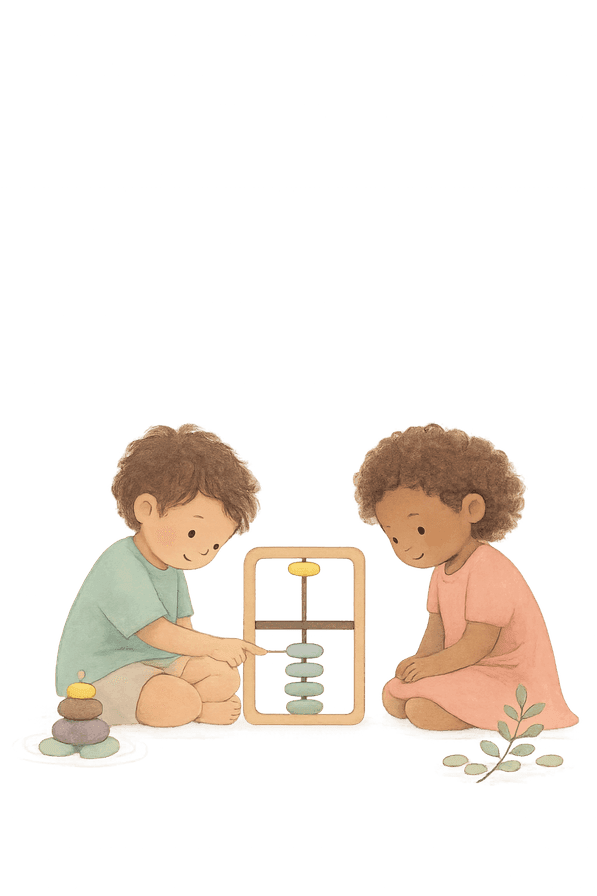
No. Pibbly does not ask a three-year-old to add, to memorise, to write or to answer quickly. A first-year child moves beads, finds numbers, and notices that four is one bead short of the gold one. Arithmetic on a soroban comes years later, if at all, and Pibbly is not a mental-arithmetic competition programme.
Will starting early put my child under pressure?
It is the opposite risk that Pibbly is built around. Sessions are 30 minutes, play-based, with songs, stories and movement, in groups of up to eight. There is no homework, no test and no ranking. Children who are not interested that week are not made to be interested that week.
What happens if we wait until school instead?
Nothing catastrophic, but something is lost. By the time formal arithmetic starts, most children have already formed an opinion about whether they are good at maths, and that opinion is very hard to move afterwards. Starting at three is not about getting ahead in arithmetic. It is about arriving at school without that opinion already made.
Is there evidence that starting early works?
The honest answer is that Pibbly is a new programme and does not have its own longitudinal evidence, and nobody should claim otherwise. What is well established in early childhood practice is that concrete materials support number understanding before symbols do, and that early attitudes toward mathematics are formed young and persist. The soroban is a concrete material. That is the whole argument, and it is not a new one.
Want to see what a session is actually like?
Thirty minutes, in a room your child already knows, in a group of up to 8. No drop-off, no drive, no extra evening.