
What is a soroban?
A soroban is the Japanese abacus. One bead above the bar is worth five. Each of the four beads below it is worth one. Only beads touching the bar are counted.
That is the entire system. Those three sentences are enough to read any digit on it, which is why it works with a three-year-old.
A single-rod soroban showing zero. Nothing is touching the bar.
How do you make a number on a soroban?
Move a bead toward the bar to count it, away from the bar to stop counting it. Tap the beads below, or use the plus and minus keys.
This is the same single-rod soroban the children use in a Pibbly session, drawn to the same anatomy: one gold bead above a dark bar, exactly four green beads below it, and a closed frame with nothing to knock over.
= 0
Tap the beads, use + / −, or focus the abacus and press the arrow keys.
What does a Pibbly soroban actually look like?
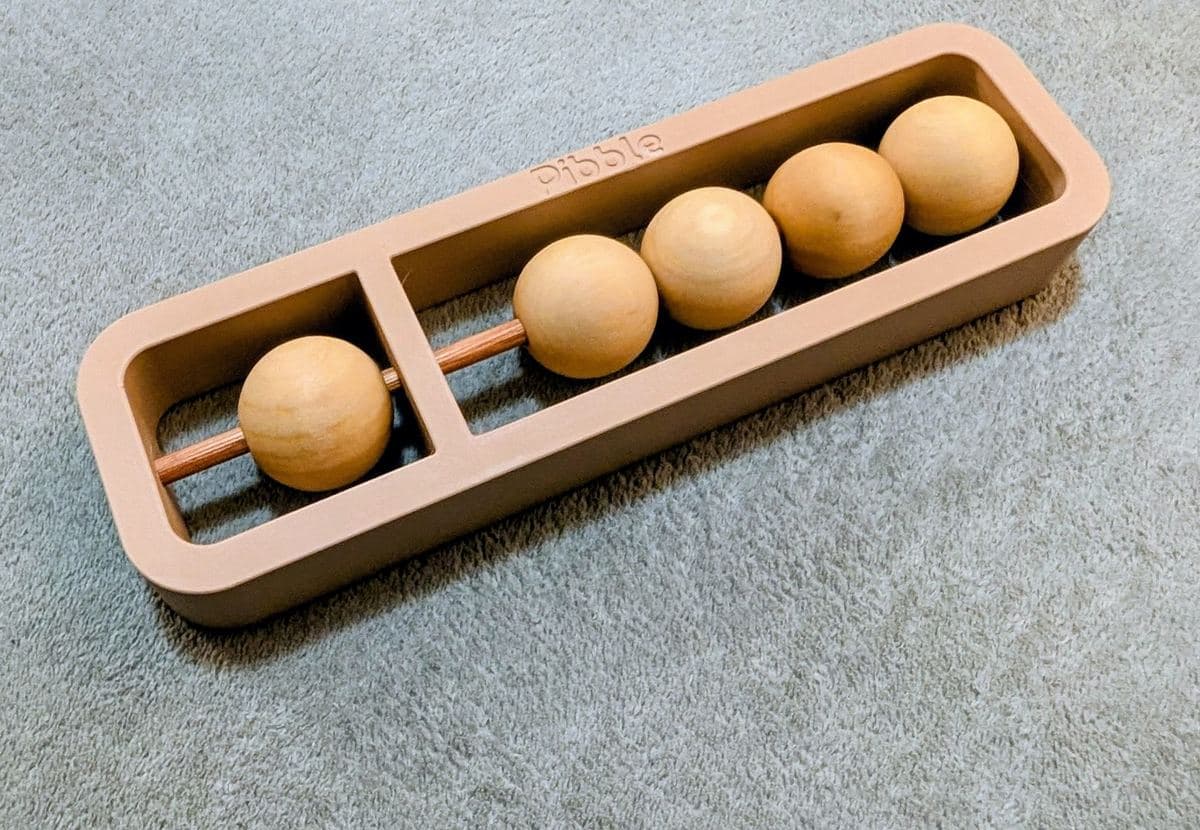
The real one. The drawings on this site colour the five-bead gold so it is easy to point at. On the timber soroban it is the bead sitting in its own compartment. Same rule, same maths, one fewer colour.
How do you read 0 to 9?
Ten arrangements, and there is only one correct way to make each of them. That is the difference between a soroban and most other abacuses.
Everything away from the bar. The gold bead is up, all four green beads are down.
One green bead up to the bar.
Two green beads up to the bar.
Three green beads up to the bar.
All four green beads up to the bar.
The gold bead down to the bar, all four green beads away from it.
The gold bead down, and one green bead up. Five and one.
The gold bead down, and two green beads up. Five and two.
The gold bead down, and three green beads up. Five and three.
The gold bead down, and all four green beads up. Five and four.
Notice what happens at five. A child does not count five beads, they move one. That single swap is the idea the whole device exists to teach.
How is a soroban different from other abacuses?
Japanese soroban
One bead above the bar worth 5, four below worth 1 each. Every number has exactly one arrangement. This is what Pibbly uses.
Chinese suanpan
Two beads above, five below. A rod can hold up to 15, so the same number can be built several ways. Powerful, and harder to learn first.
Classroom bead frame
Ten identical beads per row. A child counts them one at a time, which is the habit a soroban is designed to break.
What does a soroban do that counting does not?
It makes a number something you can see, touch and move.
See, touch and move numbers
A child-friendly single-rod soroban turns numbers into something children can see, touch and move in a concrete way.
Concrete before abstract
Children explore quantity, counting and number relationships with their hands before moving toward symbols and mental maths concepts later on.
Confidence, curiosity, calm
Short, relaxed activities and small wins help children feel safe, curious and capable with numbers.
Who puts the soroban in a child’s hands?
Every Pibbly session is run in person by Karin Jordaan, a registered teacher with a current Blue Card and QCT registration 941640, who trained as an abacus sensei in 2018. There is no roster of contractors.
Not sure what the words on this page mean? The soroban and early numeracy glossary defines every one of them in plain English.
The rest, answered
What is a soroban?
A soroban is the Japanese abacus. Each rod carries one bead above a horizontal bar, worth five, and four beads below it, worth one each. Only beads pushed against the bar are counted, so a single rod represents any digit from 0 to 9. A full adult soroban has thirteen or more rods and can represent numbers of that many digits.
How is a soroban different from a Chinese abacus?
A Chinese suanpan has two beads above the bar and five below, so each rod can hold up to 15 and the same number can be built more than one way. The Japanese soroban was simplified to one bead above and four below, which means every number has exactly one correct arrangement. That single-representation rule is what makes it teachable to young children.
How is a soroban different from the coloured abacus in most classrooms?
The wire-and-bead frame common in western classrooms has ten identical beads per row, so a child counts them one at a time. A soroban groups five into one bead, so a child stops counting and starts seeing: seven is the gold bead and two green, not seven separate objects to be tallied.
Why do young children use a single-rod soroban?
Because one rod is one idea. A single rod covers every digit from 0 to 9, which is the entire number range a three, four or five-year-old needs, and it removes place value from the picture until a child is ready for it. Pibbly uses a child-sized single-rod soroban for exactly this reason.
Does using a soroban teach mental arithmetic?
It can, eventually, but that is not what it is for at this age. Experienced soroban users picture the beads and calculate without the device, which is called anzan. Pibbly does not teach that. At ages 3 to 6 the soroban is a way to make a quantity visible and physical, and the mental side is something that may develop years later.
Do you need to be good at maths to help a child with a soroban?
No. The whole device runs on two rules: the top bead is five, each bottom bead is one, and only beads touching the bar count. If you can hold those two rules you can sit with a child and play, and that is all a family is ever asked to do.
Want your child to have one in their hands?
Every enrolled child gets their own child-friendly soroban to keep, along with a workbook, a bag and a shirt.